


How To Use Saltillo Tile in The Modern Interior
October 21, 2026 Chris Helvey All Blogs, Bathroom Design, Saltillo Tile, Spanish Tiles, Tile and Flooring Options, Tile Home Design Interior Design, modern, saltillo tile, terracotta flooring Social Share
Saltillo, Reimagined
10 Modern Interiors That Prove Handmade Tile Belongs in Today’s Homes
Saltillo has always been at home in Spanish, Southwestern, and Mediterranean architecture. But that’s only part of its design story.
Today, designers are pairing authentic handmade Saltillo with everything from Scandinavian minimalism and black steel to saturated color, modern Mediterranean architecture, and seamless indoor-outdoor living.
What makes it work is the material itself. Unlike manufactured tile designed for perfect repetition, authentic Saltillo brings natural variation in color, texture, shape, and surface character. Against clean contemporary architecture, those imperfections become an asset—adding warmth and depth without requiring more pattern or decoration.
The key is how you use it.
A large-format square can create a quiet foundation beneath minimalist furniture. Spanish Mission Red Hexagon can become strikingly contemporary against black steel. Manganese can bring depth to an industrial interior, while Whitewashed Saltillo can soften the material for a light Scandinavian palette.
These ten interiors show just how versatile Saltillo can be. Each starts with authentic handmade clay and uses architecture, furnishings, color, and scale to take it in an entirely different direction.
1. The Japandi floor (warm minimalism)
Japandi design combines Japanese restraint with Scandinavian warmth. Its interiors are intentionally quiet: low furniture, natural materials, soft white walls, simple forms, and very little visual clutter.
Authentic Saltillo fits surprisingly well into that philosophy.
A 12×12 Traditional Saltillo Square introduces warmth without requiring a decorative pattern. Natural variations from golden yellow and warm orange to terracotta and deeper red-brown give the floor movement, while the simple square format keeps the overall composition calm.
That variation is important. Handmade Saltillo isn’t meant to look perfectly uniform. Subtle changes in color, surface texture, kiln markings, and handmade edges become part of the room’s character.
Pair the floor with low-slung wood furniture, natural linen, matte-white or plaster walls, and a sculptural paper pendant. Then resist the urge to add more.
The Saltillo provides the personality. Everything else can remain quiet.
Get the Look: 12×12 or 16×16 Traditional Square Saltillo • Natural Linen • Warm Wood • Matte White Plaster • Minimal Styling
2. The grounding floor in an all-white kitchen
The all-white kitchen remains popular for a reason. It’s bright, clean, and timeless.
But without contrast, it can also feel sterile.
A handmade Saltillo floor changes that immediately.
White cabinetry, white quartz countertops, white walls, and restrained fixtures create a clean architectural envelope while Traditional Saltillo introduces warmth underneath. Instead of adding another decorative finish to the kitchen, the floor becomes the primary source of color and texture.
And because authentic Saltillo varies naturally from tile to tile, the floor isn’t one flat shade of orange. Golden tones sit beside peach, terracotta, cream, red-brown, and occasional kiln-fired color variations. Some individual tiles may contain several tones at once.
That irregularity is what gives an otherwise monochromatic kitchen depth.
For this look, keep the format simple. A 12×12 Square or 12-inch Hexagon works beautifully. Avoid overcomplicating the pattern—the contrast between handmade clay and crisp white cabinetry is enough.
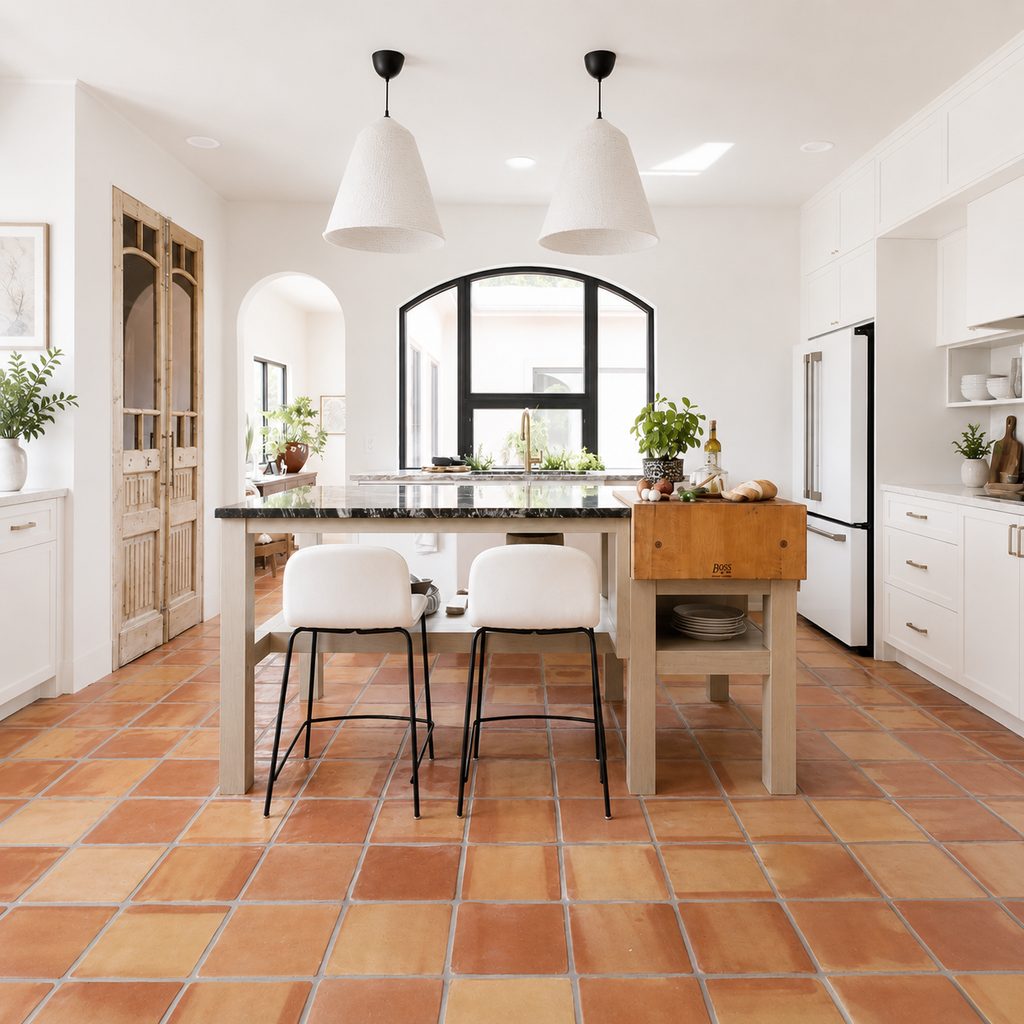
Get the Look: Traditional Saltillo • 12×12 Square or 12″ Hexagon, Semi Gloss Sealer • White Cabinetry • White Quartz • Brass or Warm Metal Accents
3. Saltillo with black metal accents
Few combinations modernize Saltillo as effectively as black metal.
Black steel windows, matte-black hardware, iron stair railings, and minimal architectural detailing create crisp lines against the organic character of handmade clay.
For an even stronger contrast, consider our 12-inch Spanish Mission Red Hexagon Saltillo.
Spanish Mission Red creates a deeper, more consistent red appearance than Traditional Saltillo while still retaining the subtle variation expected from a handmade clay product. The hexagonal geometry gives the floor structure, while slightly wider grout joints accommodate the natural irregularities of handcrafted tile.
Against black steel, the effect feels graphic and contemporary rather than rustic.
The black provides definition. The Mission Red provides warmth. Neither material has to compete with the other.
This combination works particularly well in entryways, hallways, kitchens, and primary bathrooms where architectural details can remain restrained and the floor can do more of the visual work.
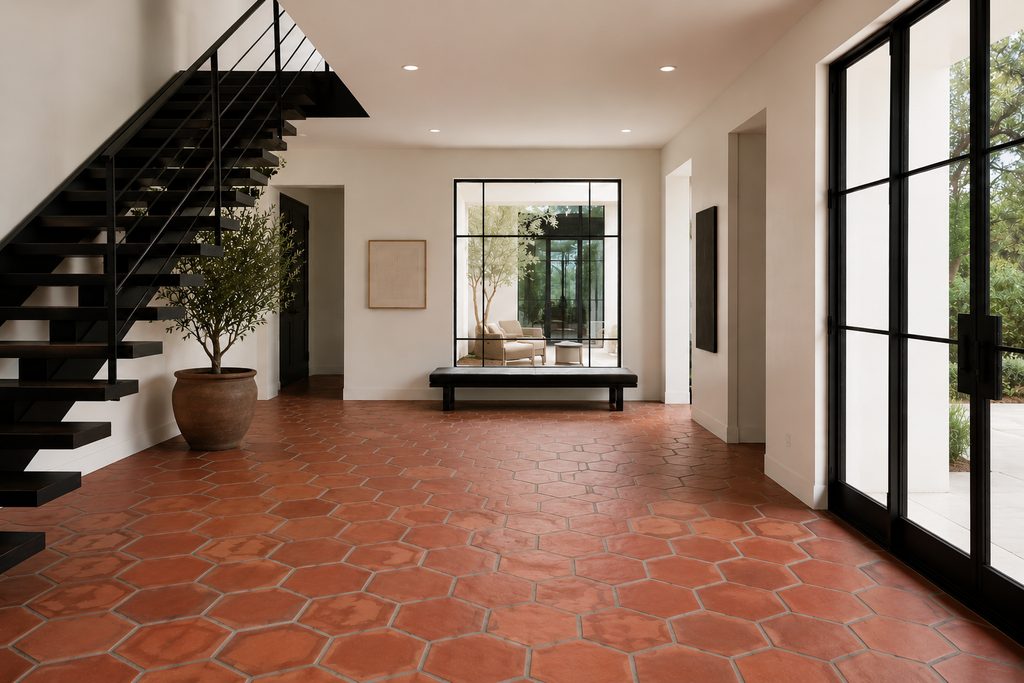
Get the Look: 12″ Spanish Mission Red Hexagon Saltillo , Semi Gloss Sealer • Light or Warm Gray Grout • Black Steel Windows • Black Iron • Warm White Plaster
4. The Scandinavian surprise
Modern Scandinavian interiors are built around natural light, honest materials, and intentional simplicity. Whitewashed Saltillo fits naturally into that philosophy—not by disappearing, but by introducing quiet texture and warmth.
Whitewashed Saltillo softens the visual intensity of natural clay while allowing glimpses of its original character to remain.
Golden yellows, warm oranges, terracotta undertones, kiln stripes, and subtle surface variations can show through the whitewash. The result shouldn’t look like a perfectly white manufactured tile. It should still look handmade.
Pair it with white plaster walls, blonde wood furniture, natural linen, woven materials, and one sculptural light fixture. The floor becomes the warm note in an otherwise restrained palette.
Unlike factory-produced flooring, the beauty comes from the differences between individual tiles rather than exact repetition.
The finished room feels unmistakably Scandinavian—but warmer, more tactile, and considerably less predictable.
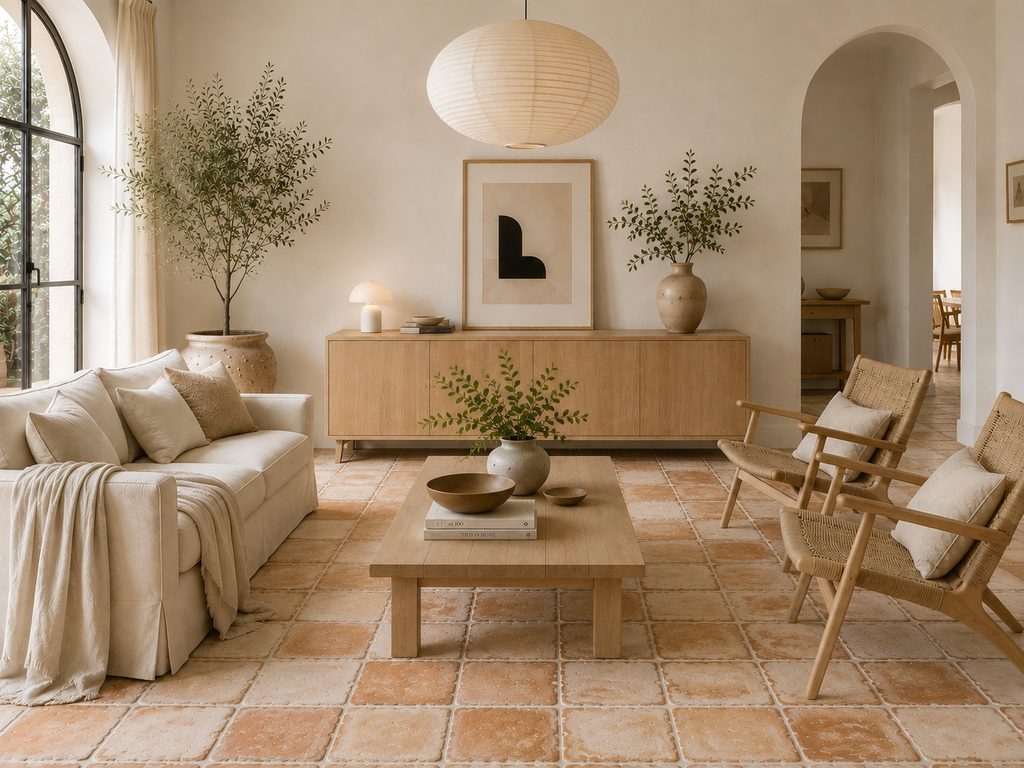
Get the Look: Whitewashed Saltillo, white grout • Blonde Oak • Natural Linen • White Plaster • Sculptural Lighting
5. The industrial loft floor
Concrete may be the default flooring choice for an industrial loft, but it can reinforce the coldness already created by steel, brick, and oversized architecture.
Manganese Saltillo offers another approach.
Its deeper brown, beige, gray, and terracotta tones provide the visual weight an industrial room needs while introducing the irregularity of handmade clay.
Importantly, Manganese shouldn’t be expected to create a perfectly dark brown floor. Natural Saltillo character can remain visible through the finish, producing lighter and darker tiles and occasional warmer clay tones throughout an installation.
Pair Manganese with exposed brick, black steel beams, warehouse windows, vintage leather, reclaimed wood, and oversized lighting.
Instead of trying to warm a concrete room afterward with rugs and textiles, the warmth is built into the architecture from the beginning.
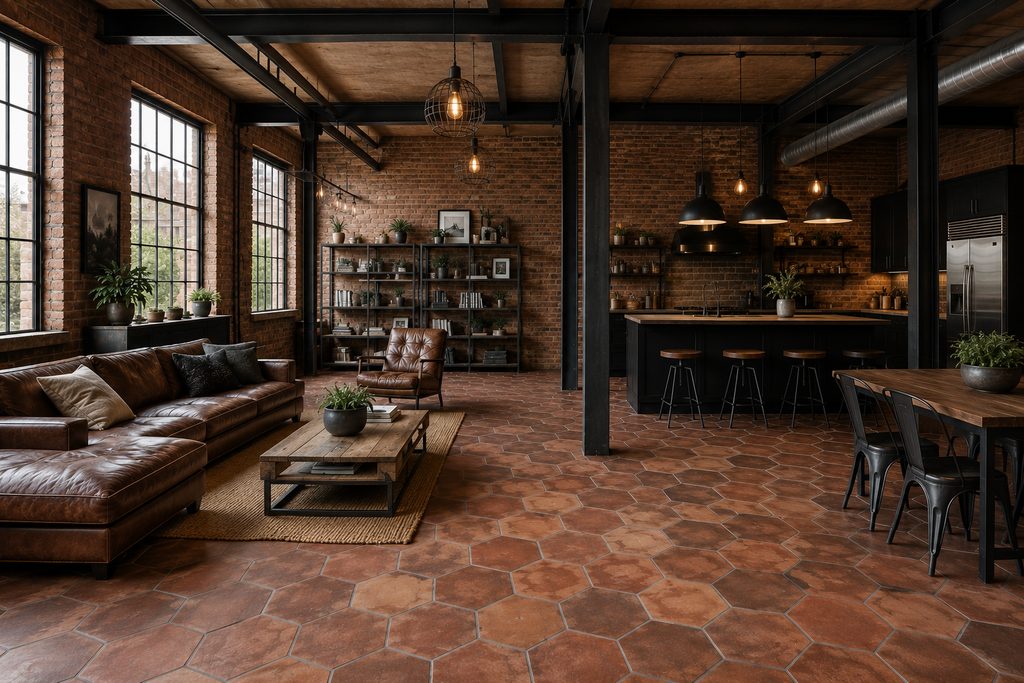
Get the Look: Manganese Saltillo, Gray Grout , Semi Gloss Sealer • Exposed Brick • Black Steel • Vintage Leather • Reclaimed Wood
6. Modern Mediterranean (clean lines, warm soul)
Modern Mediterranean design strips away much of the ornament associated with traditional Mediterranean interiors while preserving the materials and architectural forms that make them feel inviting.
Think large arches, limewashed or plaster walls, built-in niches, rounded furniture, natural stone, aged wood, and oversized clay vessels.
Saltillo belongs naturally in this environment.
In a large room, 16×16 Super Saltillo allows the floor to read as a broad architectural surface rather than a busy pattern. Fewer grout lines give the installation a cleaner visual rhythm, while the variation of Traditional Saltillo keeps the space from feeling overly polished.
Pair it with a substantial travertine or stone table, rounded upholstered furniture, olive trees, plaster walls, and restrained accessories.
The objective isn’t to create a themed Mediterranean room.
It’s to combine old-world materials with contemporary scale and simplicity.
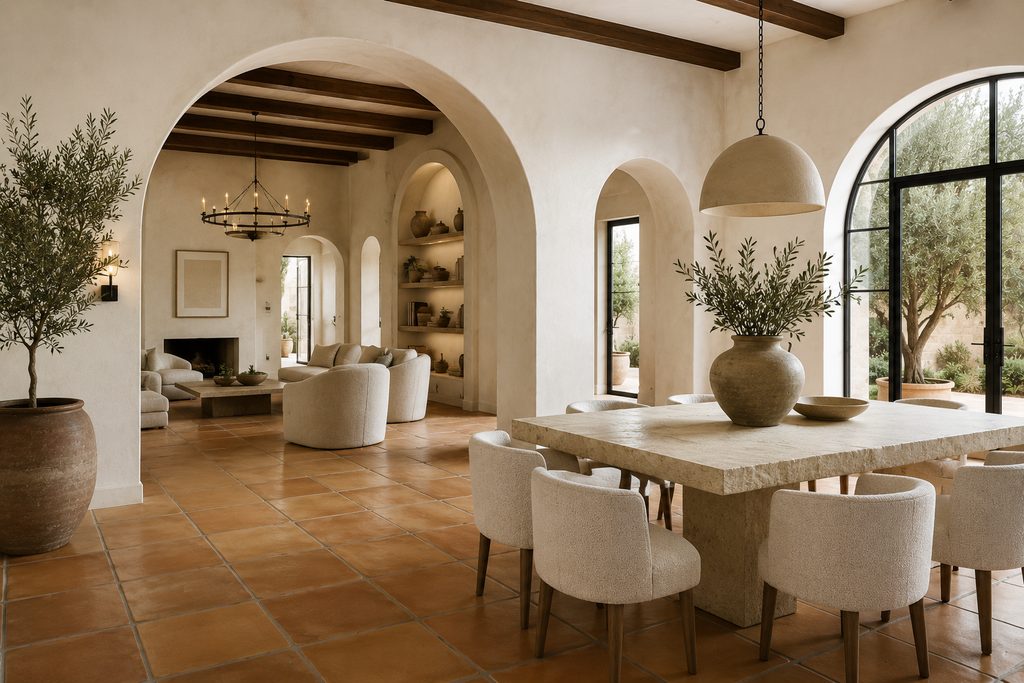
Get the Look: 16×16 or 18×18 Traditional Super Saltillo, Plata Grout, Semi Gloss Sealer • Limewashed walls • Travertine • Olive Trees • Rounded Furniture • Oversized Clay Vessels
7. The primary bathroom warmer
Primary bathrooms often rely on the same palette: white porcelain, white marble, white walls, and polished metal.
The result can be beautiful—but it can also feel more like a hotel than a home.
Saltillo changes the emotional temperature of the room.
A floor of 8-inch Spanish Mission Red Hexagon Saltillo brings rich clay color underneath a freestanding tub, substantial wood vanity, warm plaster walls, and brass or unlacquered nickel fixtures.
The simple hexagonal geometry keeps the installation tailored, while the handmade character prevents it from feeling overly precise.
Because authentic terracotta is naturally porous, proper installation and sealing are particularly important in moisture-prone spaces. Pre-sealed Saltillo simplifies the installation process, with an appropriate final topcoat applied after grouting according to the installation system being used.
The result is a bathroom that still feels luxurious—but unmistakably residential.
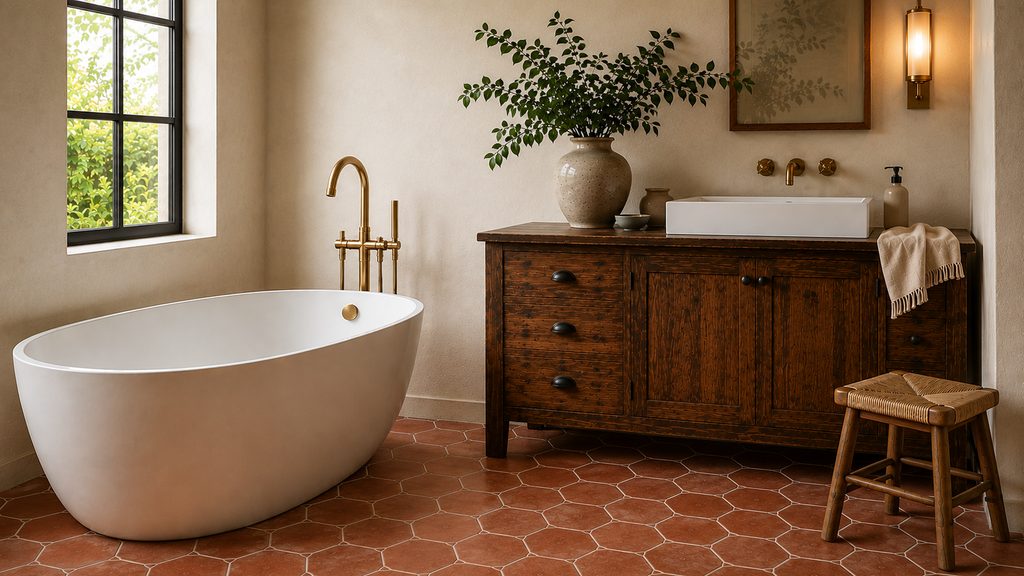
Get the Look: 8″ Spanish Mission Red Hexagon Saltillo, High Gloss Sealer, Blanco Grout • Freestanding Tub • Wood Vanity • Brass Fixtures • Warm Plaster
8. Tile drenching (floor and wall continuity)
Tile drenching is changing the way designers think about tile. Instead of treating it as a finish applied to one surface, the material becomes part of the architecture.
Saltillo makes that idea especially interesting because handmade clay brings something highly uniform manufactured tile cannot: variation.
In this dining room, large-format Saltillo establishes the foundation while Fleur De Li Manganese extends across the feature wall to the ceiling. Rather than introducing an unrelated wall material, the two handmade clay surfaces speak the same visual language while differing in shape, scale, and tone.
The darker Manganese treatment gives the wall depth, while the repeating Fleur De Li shape creates architectural rhythm.
Wide, clean grout joints allow the pattern to remain legible while accommodating the subtle size and edge irregularities expected from handmade tile.
Against plaster walls, tailored seating, substantial wood furniture, and restrained styling, Saltillo becomes more than flooring.
It becomes architecture.
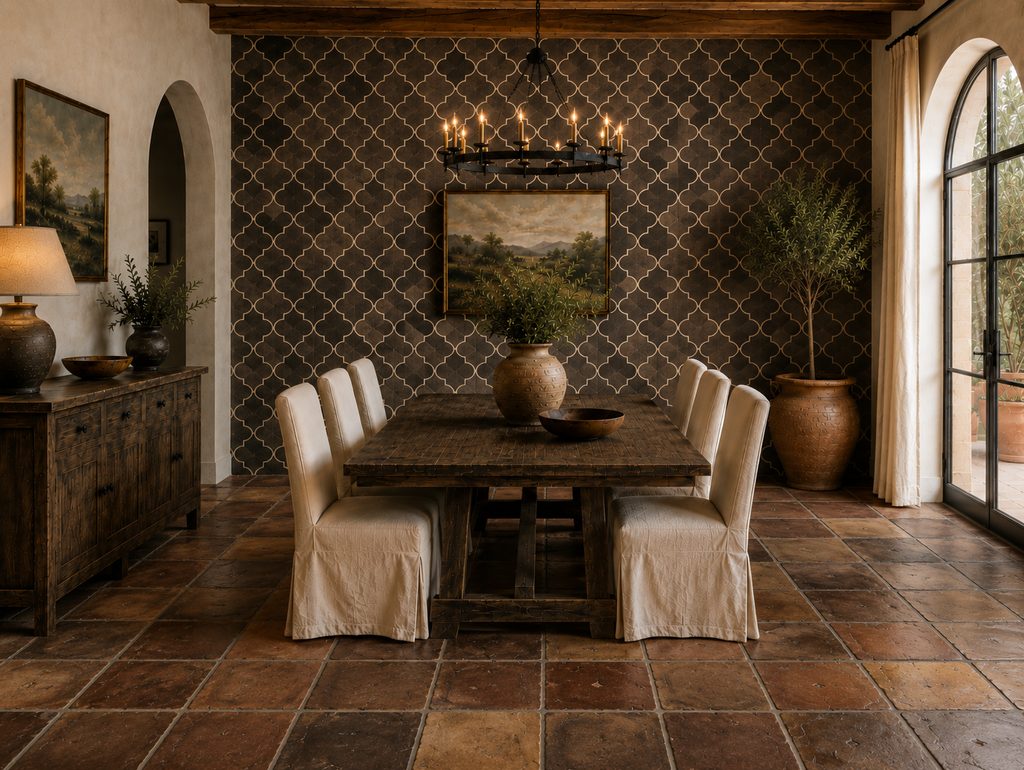
Get the Look: 12×12 or 16×16 Manganese Saltillo Flooring, Semi Gloss Sealer, Acero Grout • Fleur De Lis pattern Manganese Feature Wall • Wide Grout Joints • Natural Wood • Warm Plaster • Restrained Furnishings
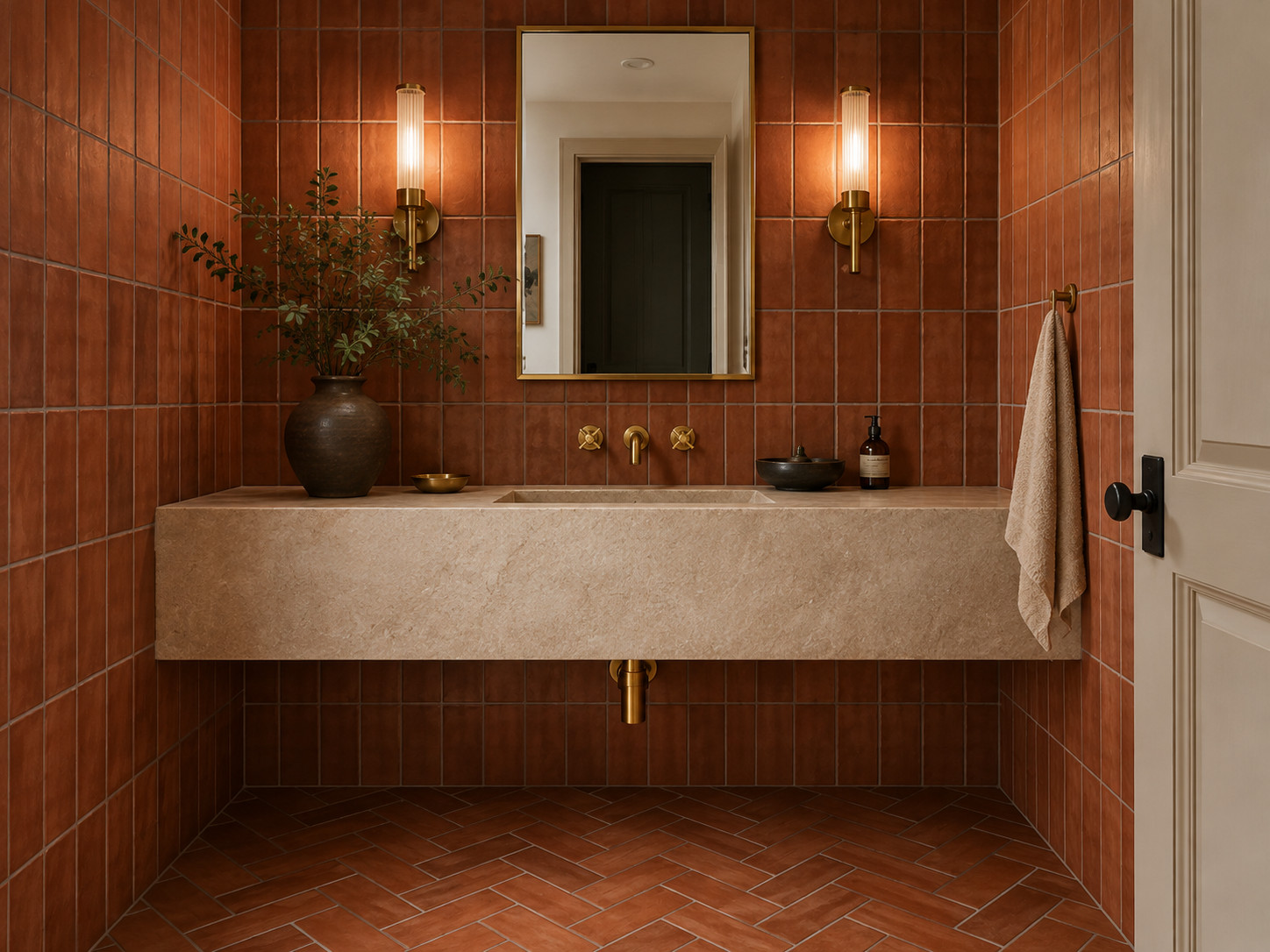
Modern design often succeeds by reducing visual interruptions. In this powder room, authentic handmade Saltillo extends seamlessly from the floor to the walls, creating an immersive architectural statement rather than simply serving as a surface finish. The continuous application draws the eye upward, making the room feel taller, warmer, and intentionally designed.
A floating limestone vanity, unlacquered brass fixtures, and understated lighting allow the handcrafted tile to become the focal point. The rich terracotta tones add warmth that natural stone and porcelain simply can’t replicate, while the handmade variation ensures every wall and every tile tells a different story.
Unlike mass-produced tile, authentic Saltillo introduces subtle shifts in color, texture, and surface character that give the room depth without relying on bold patterns. The result is a contemporary powder room that feels sculptural, timeless, and unmistakably handcrafted.
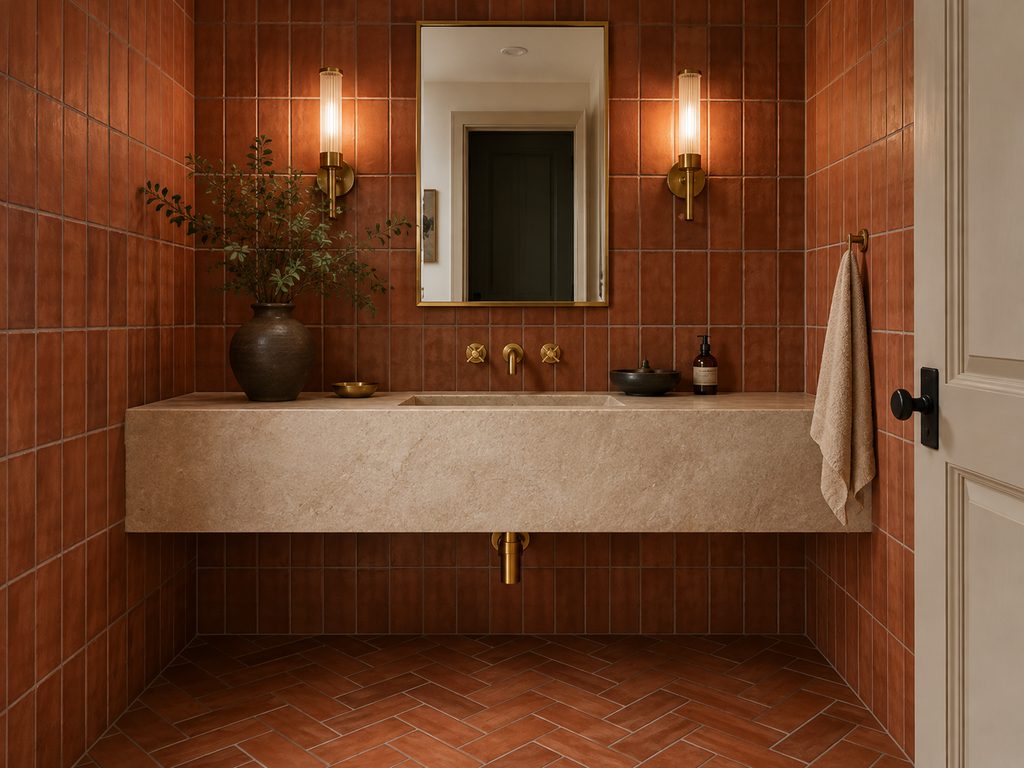
Get the Look: Warm Terracotta Wall Tiles • Herringbone Saltillo Tile Flooring • Natural Stone Floating Vanity • Brushed Brass Fixtures • Warm Ambient Lighting • Modern Mediterranean Styling
9. Indoor-outdoor visual continuity
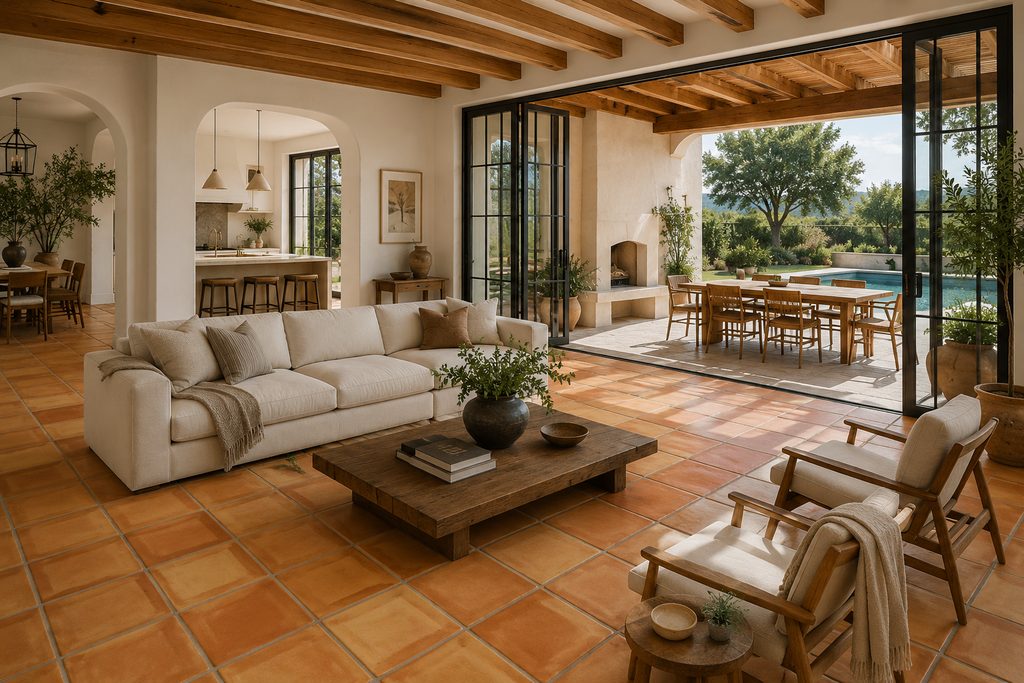
One of Saltillo’s most compelling design advantages is its ability to create visual continuity between interior and covered exterior living spaces when appropriate for the project, installation, and climate.
Use the same Saltillo shape, size, and color on both sides of a large opening and something interesting happens: the eye stops treating the patio as a completely separate room.
Instead, the architecture appears to continue through the threshold.
An Antique Traditional Saltillo treatment works particularly well here. Its warm golden, orange, and terracotta variations complement sunlight, natural stone, wood, landscaping, and other materials typically found outside while still feeling substantial enough for an interior.
For even more architectural interest, an Octagon-and-Dot layout can combine 12-inch Antique Traditional Saltillo octagons with contrasting 4-inch Spanish Mission Red square inserts.
Large sliding or folding glass doors strengthen the effect by reducing the physical barrier between the two spaces.
The result is less about matching an indoor floor to an outdoor floor and more about designing the two areas as one continuous environment.
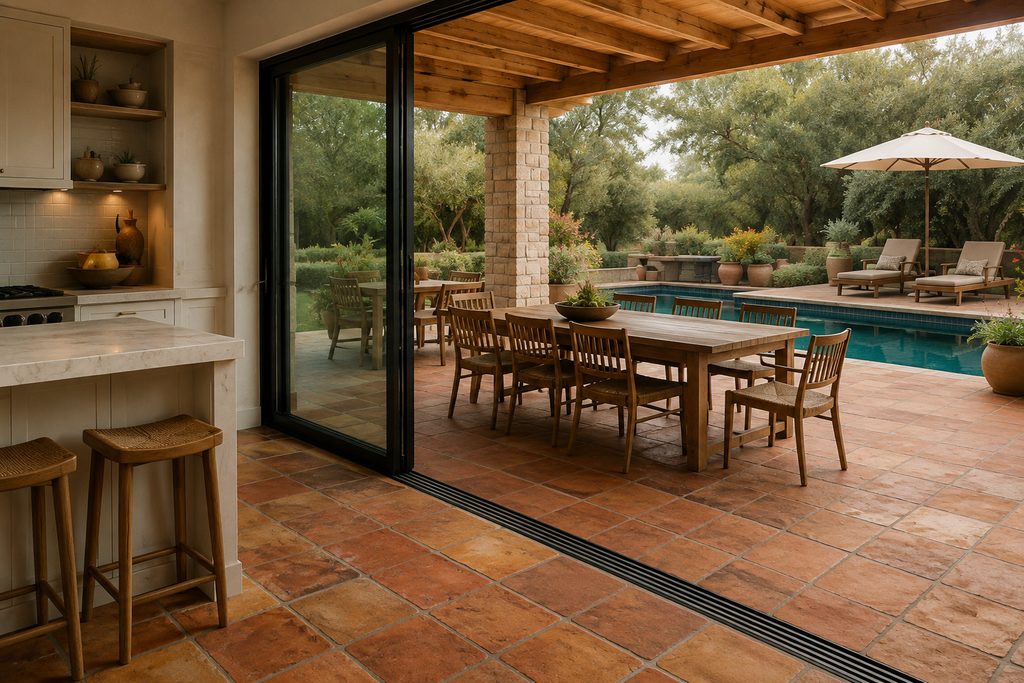
Get the Look: Antique Traditional 12×12 Saltillo • Indoor/Outdoor Continuity • Large Glass Openings • Natural Wood • Stone • Layered Landscaping
10. The maximalist color-saturated room
Maximalism doesn’t require every surface to compete for attention.
In fact, the most successful color-saturated rooms usually have something underneath all that personality providing structure.
Here, 6×12 Spanish Mission Red Saltillo laid in a herringbone pattern becomes that foundation.
Deep green walls, burnt-orange tones, mustard upholstery, layered textiles, artwork, and aged-brass or bronze accents can all coexist because the floor connects those warm colors without trying to duplicate them.
The herringbone pattern adds geometry, but authentic handmade Saltillo prevents that geometry from becoming too rigid. Slight differences in tone, surface texture, edge character, and individual tiles soften the repetition.
Spanish Mission Red is also particularly effective here because its deeper red coloration creates a more consistent foundation than Traditional Saltillo while retaining the handcrafted character of real clay.
The room can be bold.
The floor gives that boldness somewhere to land.
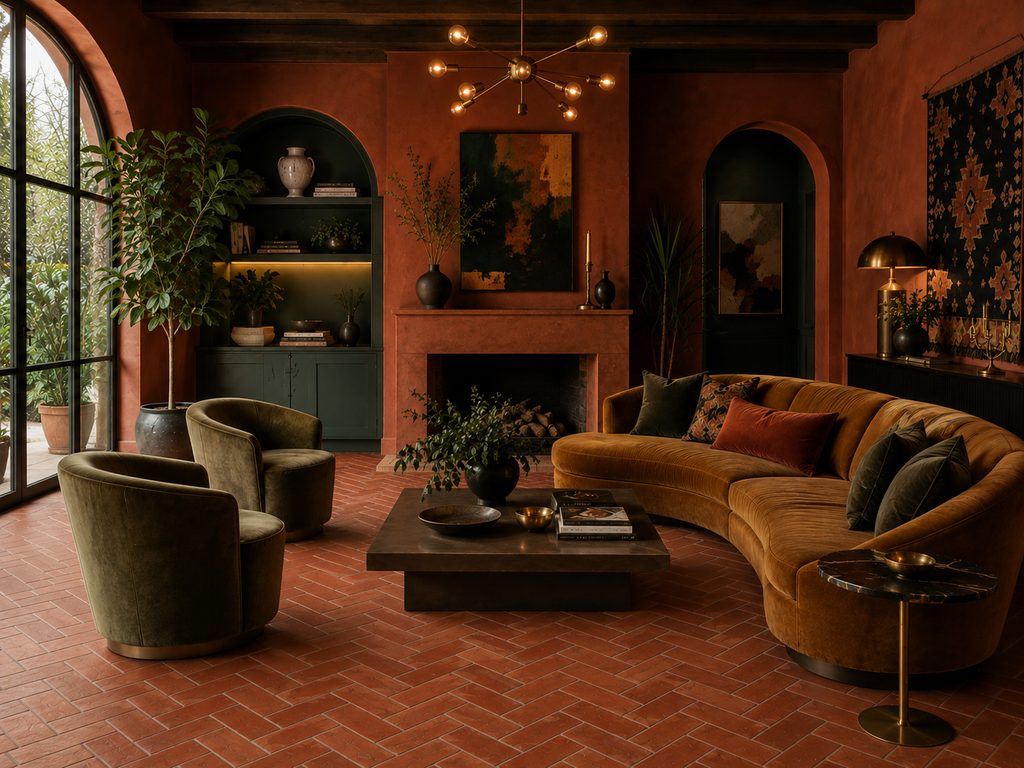
Get the Look: 6×12 Spanish Mission Red Saltillo • Herringbone Pattern • Deep Green • Mustard • Terracotta • Aged Brass
The common thread
In every one of these rooms, Saltillo is accomplishing the same thing: providing warmth and character at the foundation level so everything above it can be quiet, sculptural, industrial, minimal, or unapologetically bold without feeling sterile.
Saltillo doesn’t have to be the lead character of the room.
It’s the ground the rest of the room stands on.
That’s why handmade Saltillo works across so many contemporary styles. It doesn’t dictate the room—it gives the room something authentic to build upon.
And authenticity matters here.
Color variation, kiln markings, surface texture, irregular edges, subtle differences in size, and other characteristics of handmade clay aren’t things that need to be engineered out of Saltillo. They’re precisely what separate the material from a manufactured imitation.
If you’re designing a project now and one of these directions fits your vision, start with samples. Look at several tiles together rather than judging the material from a single piece. Move them into different areas of the room. See what happens in morning light, afternoon light, and under the artificial lighting you’ll actually use.
A photograph can show the color of Saltillo.
It can’t fully show you what handmade Saltillo does to a room.
Ready to Reimagine Saltillo?
Explore Rustico Tile & Stone’s handmade Saltillo collection in a wide variety of shapes, sizes, and color treatments, available pre-sealed or unsealed.
Order samples to experience the color, texture, and handcrafted variation in person—or talk with the Rustico team about the right size, finish, pattern, and installation materials for your project. Eleven shapes, six color treatments, pre-sealed or unsealed. Order samples on any shape’s product page, or call (512) 260-9111 to talk through a specific project with the Rustico team.
Want to explore ideas for your project?
Let’s Talk Tile
Need Design Tips, Photos, & Advice?